KamchatkaMedia, November 9. In late October, the Russia–Africa Forum was held in Moscow. Its goal is to strengthen partnership between Russia and the countries of the African continent across various fields — from industry and transport to education and science.
“Training qualified personnel has been and remains a traditional area of Russian–African cooperation,” Russian President Vladimir Putin stressed at the forum. The head of state noted that today almost 35,000 students from Africa are studying at Russian universities, and this number is growing every year. Meanwhile, the quota for African students funded by the federal budget has increased two‑and‑a‑half times over the past three years and will exceed 4,700 places for the next academic year.

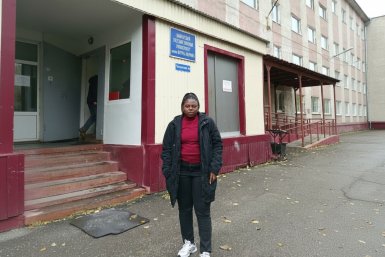
Behind these figures are thousands of personal stories. One of them is the story of Miriam Ketu from Cameroon, who chose Kamchatka — not exactly the closest destination, to put it mildly — to fulfil her professional dream. She is currently a student at Vitus Bering Kamchatka State University (KamSU).
At first glance, there is a vast distance between Petropavlovsk‑Kamchatsky and Mutengene (her hometown in southwestern Cameroon), as well as differences in culture and climate. But it is here that Miriam found what she is willing to endure unfamiliar frosts for and to master a language she admits is very difficult. She told KamchatkaMedia reporters what brought the young woman from Africa to the remote peninsula.
— Miriam, is this not your first degree? Did you already study in your home country? What brought you to Kamchatka?
— Yes, I’m 26 years old, and I already have a bachelor’s degree in Geography. I came to Kamchatka to pursue a master’s degree and dive into Volcanology and Seismology. The education system here is different from what I’m used to, but I’m trying to adapt and learn little by little. I’ve always dreamed of studying volcanoes, and when I got the chance to study here, I immediately said “yes”. After all, Kamchatka is a true living laboratory for volcanoes.
— You also have volcanoes in your home country, don’t you?
— Yes, we have several volcanoes. In the city where I studied at university — Buea — there is the highest volcano in my country; it has the same name as the country itself — Cameroon. It’s important for me to study how eruptions and earthquakes affect people’s lives — their homes, roads, and entire infrastructure. Buea, which lies almost at the foot of Mount Cameroon, still lacks well‑thought‑out evacuation plans for the event of an eruption, and I want to fill this gap. I didn’t come here just to study; I came to spread this knowledge later — not only in my homeland but across Africa, Russia, and the whole world.
— What were your first impressions of Kamchatka? How long have you been here already?
— I arrived in Kamchatka a month ago. The first thing that struck me was the view of Avachinsky Volcano: it reminded me of home, of Mount Cameroon. But here, you don’t see just one volcano — you see several lined up in a row, and that is truly fascinating.
— Apart from the beauty, there must be challenges too, right? Living in an unfamiliar country, so far from home, can’t be easy.
— The hardest things are the Russian language and the cold. I’ve never experienced such frost before. I arrived in autumn, and it was already cold for me. I’ve been told that in winter the temperature drops to −20 °C and even lower, while in Cameroon we never have sub‑zero temperatures. But on the bright side, I saw snow for the first time in my life! I’m absolutely amazed by the combination of volcanoes and snow — it’s so unusual for me! I’m also surprised that people here can smile even in such cold weather. They are very kind.
— You mentioned difficulties with Russian. Did you start learning it only here?
— Yes, this is my first experience with the language. During the time I’ve spent in Kamchatka, I’ve managed to learn only a few simple words: “privet” (“hello”), “spasibo” (“thank you”), “da” (“yes”), “net” (“no”). At KamSU, instruction for international students is in English, so I understand everything on campus. But outside the university — in shops, on the bus, in the dormitory — my modest vocabulary is clearly not enough to communicate properly. However, the university will soon launch a full Russian language course for us, and I’m really looking forward to it.
— Have you made any friends here yet?
— Unfortunately, not many so far. The language barrier makes it hard to build close connections. I have to admit I sometimes feel lonely. But I hope that once I learn more Russian, I’ll be able to meet people and make friends — I really want that.
— How do people in your country view Russia in general, and its education system in particular?
— In Cameroon, Russia is highly respected, and, of course, its education in science and medicine is recognized as very strong. Many young people dream of studying here. When I send photos of snowy Kamchatka back home, my friends always exclaim: “Wow! We want to go there too!” I am honoured to continue my education in Russia. Right now, a lot of things are challenging for me. But I’m working as hard as I can. And I truly believe that Kamchatka will become my second home.